
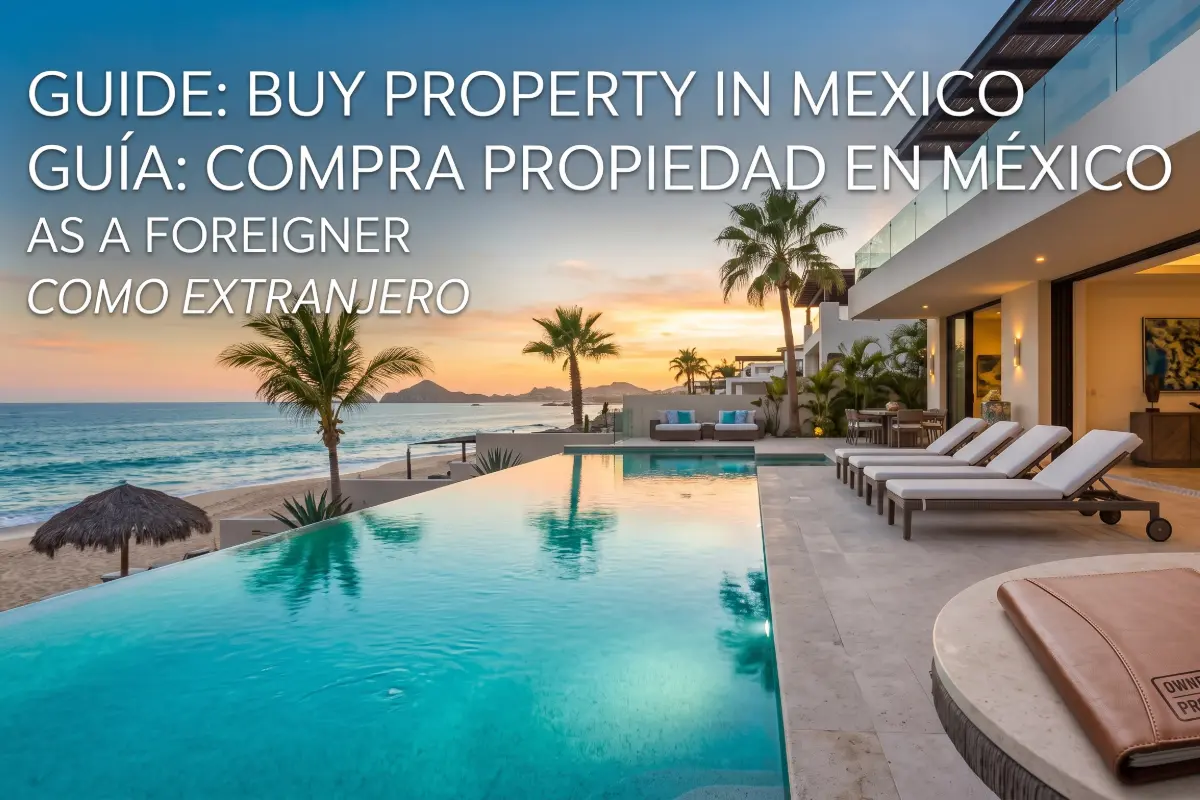
Imagine waking up to ocean breezes on your private terrace in Cabo San Lucas, Puerto Vallarta, or the Riviera Maya. You sip your morning coffee knowing that your luxury home is 100% legally and permanently yours.
For decades, real estate myths have held international buyers back: "Foreigners can't own coastal land," "The government seizes foreign property," or "You need a Mexican national to hold your title."
Here is the reality: Foreigners can legally, safely, and permanently buy real estate in Mexico—including prime beachfront property.
Mexico actively welcomes international buyers and provides federal-level legal frameworks to protect your investment. However, buying property here follows civil law procedures that differ from North American or European systems.
This guide breaks down the precise legal pathways, actual closing costs, transaction milestones, and critical risks to avoid—helping you navigate the process with total confidence.
1. Can Foreigners Legally Own Beachfront Property in Mexico?
Yes, absolutely. Under Article 27 of the Mexican Constitution, the government originally prohibited foreign nationals from holding direct title to land in strategic border and coastal zones, known as the Restricted Zone.
What Is the Restricted Zone?
The Restricted Zone covers all land located within:
-
50 kilometers (~31 miles) of any ocean coastline.
-
100 kilometers (~62 miles) of any international land border.
Because Mexico’s top retirement and vacation markets—such as Cabo San Lucas, Cancun, Tulum, Playa del Carmen, and Puerto Vallarta—fall inside this coastal strip, buyers use secure legal mechanisms established by federal law.
+-----------------------------------------------------------------+
| THE RESTRICTED ZONE |
| |
| [ International Border ] <--- 100 km (~62 miles) ---> [ Inland ] |
| |
| [ Ocean Coastline ] <--- 50 km (~31 miles) ---> [ Inland ] |
+-----------------------------------------------------------------+
How Foreign Ownership Works
To encourage foreign capital, Mexico passed the Foreign Investment Law (Ley de Inversión Extranjera). This law guarantees clear ownership pathways based on property location:
-
Inland Properties (Outside the Restricted Zone): In interior destinations like San Miguel de Allende, Mexico City, or Guadalajara, you hold direct deed title (Escritura Pública) in your own name, exactly like a Mexican citizen. (Explore our guide on the best places to live in Mexico to compare inland vs. coastal markets.)
-
Coastal & Border Properties (Inside the Restricted Zone): You buy residential real estate through a Fideicomiso (a bank trust) or set up a Mexican corporation for commercial projects.
2. Holding Title: Fideicomiso vs. Mexican Corporation vs. Direct Deed
Your property's location and purpose dictate the best legal structure for your title.
|
Feature / Criteria |
Fideicomiso (Bank Trust) |
Mexican Corporation (S.A. de C.V.) |
Direct Deed (Escritura) |
|
Ideal Use Case |
Personal homes, second residences, and individual vacation rentals. |
Commercial real estate, multi-unit developments, 3+ rental units. |
Residential homes located outside the Restricted Zone (Inland). |
|
Location |
Inside the Restricted Zone (Coasts & Borders). |
Anywhere in Mexico (commercial intent inside the restricted zone). |
Non-Restricted Zone only. |
|
Titleholder |
Mexican Trustee Bank (for your exclusive benefit). |
The Mexican Corporation (100% foreign-owned). |
You directly (fee-simple ownership). |
|
Initial Setup Cost |
$1,500 – $2,500 USD. |
$2,000 – $3,200 USD. |
Standard notary deed fees apply. |
|
Annual Maintenance |
$500 – $900 USD/year (trustee fee). |
$1,500 – $3,000 USD/year (corporate accounting & monthly tax filings). |
$0 (only standard annual predial property taxes). |
|
Term Length |
50-year term, renewable indefinitely. |
Unlimited (active corporate entity). |
Unlimited. |
How a Fideicomiso Protects Your Rights
A Fideicomiso is not a lease or a temporary concession. It is a 50-year renewable bank trust created by federal decree. Three parties participate in the trust:
-
The Settlor (Fideicomitente): The seller transferring the title.
-
The Trustee (Fiduciario): A regulated Mexican bank, such as BBVA Mexico Bank Trust Division, acting as title custodian.
-
The Beneficiary (Fideicomisario): You, the foreign buyer, holding 100% of the beneficial rights.
Asset Protection Guarantee: The trustee bank holds title solely for your benefit. Under Mexican banking law, trust assets remain completely off the bank's balance sheet—meaning creditors cannot attach or touch your property. You maintain full authority to live in, renovate, lease out, sell, or pass the property to designated heirs without undergoing local probate court. If you plan to generate rental income, check out our Mexico short-term rental investment strategy.
3. The 6-Step Purchase Process (From Offer to Keys)
A standard resale purchase in Mexico takes between 60 and 90 days from signed contract to final closing.
1. Sign the Offer & Promissory Contract (Contrato de Promesa): Weeks 1–2.
Your attorney drafts a formal Contrato de Promesa de Compraventa. This legally binding agreement outlines the purchase price, payment milestones, inspection contingencies, and closing dates. You deposit earnest money (typically 5%–10%) into a secure escrow account.
2. Assemble Your Professional Legal Team: Week 2.
Hire an independent buyer's attorney and select a Notario Público. In Mexico, the Notario Público is a governor-appointed senior legal official who verifies title validity, reviews land records, calculates transfer taxes, and executes official public deeds. Check credentials through the Colegio Nacional del Notariado Mexicano.
3. Secure Your Foreign Permit (Permiso SRE): Weeks 3–6.
Your legal team submits Form SRE-04-001 to the Secretaría de Relaciones Exteriores (SRE). This official permit authorizes you to purchase real estate inside the Restricted Zone under the Calvo Clause.
4. Establish or Transfer Your Fideicomiso: Weeks 5–8.
Your bank creates a new Fideicomiso trust deed. If you are buying a resale property from a foreign owner, you can often assume their existing trust (Cesión de Derechos) to lower setup costs and accelerate closing.
5. Complete the Official Valuation Appraisal (Avalúo): Weeks 7–9.
A licensed municipal appraiser inspects the property to determine its official valuation (Avalúo Oficial). The notary uses this report to calculate your exact municipal acquisition taxes.
6. Execute the Public Deed & Transfer Ownership: Weeks 9–12.
Wire your remaining purchase funds into escrow. Both parties sign the public deed (Escritura Pública) before the Notario Público. The notario collects transfer taxes, releases funds to the seller, and registers your deed in the Public Registry of Property (Registro Público).
4. Complete Closing Cost Breakdown: What You Will Actually Pay
In Mexico, buyers pay almost all closing fees, while sellers pay real estate commissions and Capital Gains Tax (ISR).
Budget 5% to 8% of the purchase price in closing costs. Lower property values trend toward the 8% mark because fixed legal and government fees make up a larger percentage of the total price.
Buyer Closing Costs ($300,000 USD Property Example)
|
Fee Description |
Payee / Institution |
Calculation Rate |
Estimated USD |
|
Acquisition Tax (ISAI / ISABI) |
Municipal Treasury |
2.0% – 4.0% of purchase or appraised value. |
$6,000 – $12,000 |
|
Notary Legal Fees |
Notario Público |
1.0% – 1.5% of transaction value. |
$3,000 – $4,500 |
|
SRE Foreign Permit & RNIE Registration |
Ministry of Foreign Affairs |
Flat government filing fee. |
$1,200 – $1,800 |
|
Fideicomiso Setup Fee |
Trustee Bank |
One-time creation fee. |
$1,500 – $2,500 |
|
Official Appraisal (Avalúo) |
Certified Appraiser |
Flat fee scaled by property size. |
$400 – $800 |
|
Public Registry Fees |
Property Registry |
0.3% – 0.8% of assessed value. |
$1,000 – $2,000 |
|
Escrow Service Fee |
Independent Escrow |
Flat transaction management fee. |
$600 – $1,200 |
|
Total Estimated Closing Costs |
— |
~5.5% – 7.5% |
$16,500 – $22,500 |
Annual Recurring Taxes & Maintenance
Holding property in Mexico remains exceptionally affordable:
-
Property Tax (Predial): Municipalities assess Predial at very low rates—typically 0.1% to 0.3% of cadastral value. Annual property taxes on a $300,000 USD home rarely exceed $300 to $500 USD per year. Paying in January or February unlocks early-bird municipal discounts of 10%–20%. (Compare this with overall expenses in our guide to the cost of living in Mexico.)
-
Annual Fideicomiso Fee: Your trustee bank charges an annual administration fee of $500 to $800 USD.
5. Critical Risks & How to Avoid Them
Protect your investment by following four non-negotiable safety rules:
1. Avoid Un-regularized Ejido Land
Ejidos are communal agricultural lands established after the Mexican Revolution. Foreigners cannot legally purchase Ejido land.
Unscrupulous sellers may pitch Ejido plots using informal certificates (certificados parcelarios). Unless an Ejido parcel completes full privatization (Dominio Pleno) and receives an official deed (Escritura) recorded in the Public Registry, walk away.
Red Flag Checklist: Never hand over cash or sign a deposit agreement until your lawyer confirms a clean Certificado de Libertad de Gravamen (Certificate of Free Encumbrance) issued directly by the Public Registry.
2. Comply with Anti-Money Laundering Laws (LFPIORPI)
Mexico’s Federal Anti-Money Laundering Law (LFPIORPI) classifies real estate transactions as sensitive financial activities. Expect your notary and bank to collect complete Know Your Customer (KYC) records, valid IDs, and clear wire receipts proving the origin of your purchase funds.
3. Obtain a Tax ID (RFC) for Rental Properties
If you rent your property on platforms like Airbnb or VRBO, you are generating local income. Under guidelines from the Servicio de Administración Tributaria (SAT), foreign owners must register for a Mexican Tax ID (RFC).
Without an active RFC, platforms must withhold up to 36% of your gross rental earnings under Airbnb Mexico Tax Retentions rules. Having an RFC lets you file regular returns and deduct legitimate operating expenses. Learn the exact process in our step-by-step breakdown on how to apply for an RFC tax ID in Mexico.
4. Always Use Independent Escrow Services
Never wire purchase funds directly to a seller or agent's personal account. Use a licensed cross-border provider like Stewart Title Escrow Services. Escrow holding protects your deposit until the notary verifies clear title and both parties sign the public deed.
6. Financing Real Estate in Mexico
While cash purchases dominate the market, three viable financing paths exist:
-
Home Equity Lines of Credit (HELOC): Tapping equity from assets in your home country usually offers the lowest interest rates. You secure domestic financing and buy in Mexico as a cash buyer.
-
Cross-Border USD Mortgages: Specialized international lenders offer USD loans secured by Mexican real estate. Expect 50% to 65% Loan-To-Value (LTV) limits, interest rates between 8.5% and 10.5%, and standard credit qualification.
-
Developer Financing: Common in pre-construction projects in markets like Baja California Sur. (Check out the latest Cabo San Lucas real estate market trends). Developers typically ask for a 30% down payment, 40% in construction installments, and the remaining 30% upon delivery or financed over 3–5 years.
Note: While buying real estate does not grant automatic residency, owning property above certain value thresholds simplifies applying for a visa. Read our Mexican temporary residency visa guide to learn more.
7. Frequently Asked Questions (FAQs)
Do I need Mexican residency to buy property?
No. Real estate ownership is an investment transaction completely separate from immigration status. You can legally purchase property using a standard tourist passport.
What happens to my Fideicomiso property if I pass away?
Your property transfers seamlessly. Inside your Fideicomiso trust deed, you name primary and secondary substitute beneficiaries (Fideicomisarios Sustitutos). Upon death, ownership passes directly to your named heirs without going through Mexican probate court.
How long does a Fideicomiso last, and how do I renew it?
A Fideicomiso is issued for a 50-year term and can be renewed indefinitely for additional 50-year periods through a routine administrative filing with your trustee bank.
Can I sell my Fideicomiso property to a non-Mexican buyer?
Yes. You can sell your property to another foreign buyer by assigning your existing trust rights (Cesión de Derechos) or by canceling your trust so the buyer can establish a new one.
Ready to Find Your Dream Property in Mexico?
Navigating real estate in Mexico is clear and secure when you follow the right legal framework. By utilizing a bank trust (Fideicomiso), hiring an independent attorney, and working with an accredited Notario Público, you can purchase your piece of paradise with complete peace of mind.