
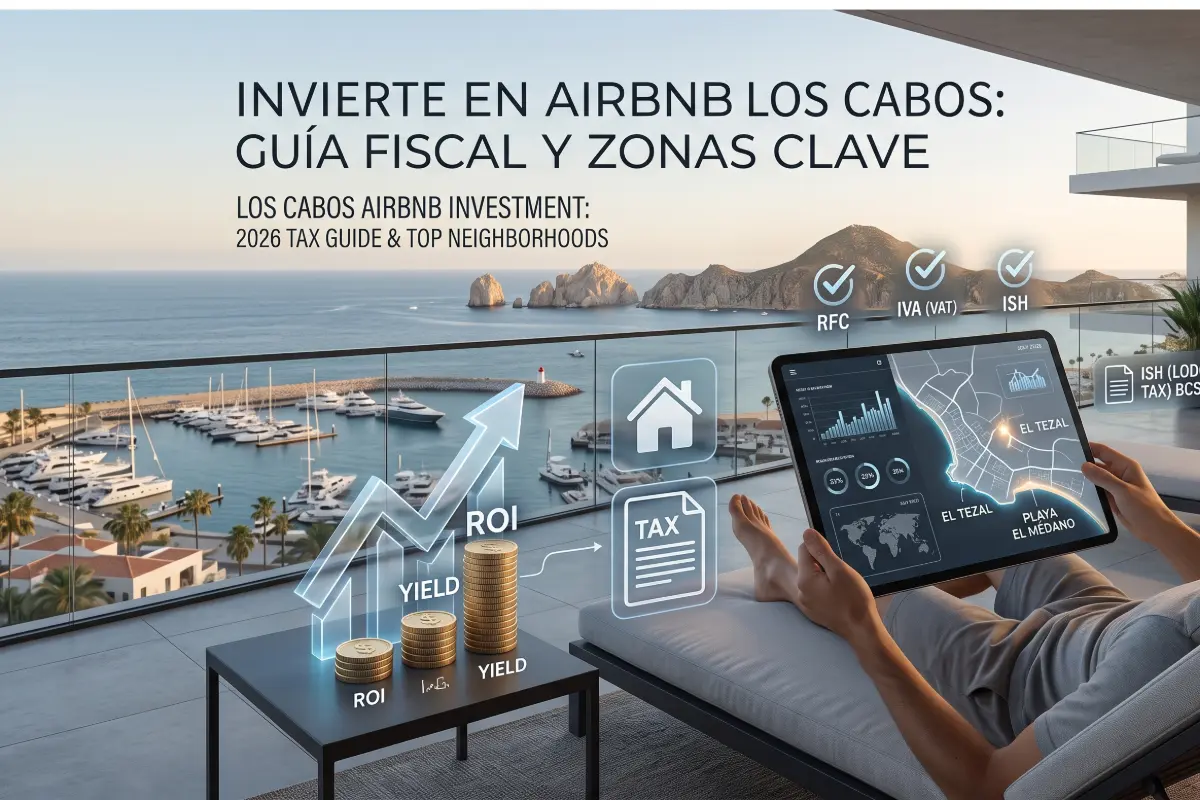
Few resort destinations in North America match the investment performance of Los Cabos. Positioned at the southern tip of Baja California Sur, where the Gulf of California meets the Pacific Ocean, Los Cabos has evolved into a premier luxury market. Direct flights from major US and Canadian hubs, a thriving hospitality sector, and an expanding remote-worker population consistently drive high dollar-denominated rental yields for vacation property owners.
However, building a profitable Airbnb in Los Cabos requires more than acquiring a property with an ocean view. Long-term profitability depends on mastering Mexico's tax regulations and strategically purchasing in neighborhoods that match your target guest demographic. Before buying, review our complete Los Cabos real estate investment guide to understand the broader market dynamics.
This guide provides a clear breakdown of federal tax compliance, state lodging taxes, neighborhood yield benchmarks, and essential legal frameworks for international real estate investors.
1. Los Cabos Vacation Rental Market Analysis: Yields, ADRs, and Demand
Before reviewing tax codes or neighborhood maps, investors must analyze the core economic drivers shaping short-term rental performance across Baja California Sur. Real-time data from the AirDNA Los Cabos Market Overview highlights how strategic location directly impacts gross occupancy and nightly revenue.
Gross Booking Revenue
├── Operating Overhead (Property Management 15–25%, Utilities, HOA)
├── Tax Obligations (SAT ISR Income Tax, BCS 4% ISH Lodging Tax)
└── Net Operating Income (Target Net Yield: 4.0% – 8.0%)
Key Performance Benchmarks
Los Cabos features a wide pricing spectrum. Mid-market condominiums deliver steady year-round occupancy, while expansive cliffside estates elevate regional performance metrics:
-
Average Daily Rate (ADR): The market-wide ADR averages $415 USD per night. Mid-market condos typically range from $140 to $280 USD per night, whereas luxury estates command $800 to $2,500+ USD per night.
-
Revenue Per Available Room (RevPAR): Market RevPAR averages $124 USD. Entry-level units average $30 USD RevPAR, median listings achieve $61 USD, and top-tier luxury villas reach $122 to $299 USD RevPAR.
-
Gross Rental Yields: Net annual rental yields average between 4.0% and 8.0%, depending on acquisition costs, HOA fees, and active tax management.
Seasonal Demand Trends
According to tourism tracking from the Los Cabos Tourism Board (FITURCA), visitor arrivals follow three distinct seasonal cycles:
-
Peak Season (December – April): Delivers high occupancy (40%–50%+) and peak nightly rates. Winter snowbirds, holiday vacationers, and spring break travelers drive this surge.
-
Shoulder Season (May – July): Maintains steady occupancy (~34%) with moderate daily rates. Sportfishing tournaments, summer family trips, and destination weddings support demand.
-
Low Season (August – October): Yields lower occupancy (~30%), requiring dynamic pricing strategies. Owners frequently utilize this window for annual property maintenance and personal stay.
2. Navigating Mexican STR Tax Laws: RFC, ISR, IVA, and Lodging Taxes
Operating a vacation rental in Mexico constitutes a regulated commercial activity. The Servicio de Administración Tributaria (SAT) enforces federal tax compliance, while digital platforms like Airbnb and Vrbo must withhold taxes at payout under the Airbnb Mexico Tax Information Center framework.
Critical Warning: Operating a short-term rental without a registered Mexican Tax Identification Number (RFC) triggers maximum default platform withholdings of up to 36% from gross earnings, while blocking all operational expense deductions.
Understanding the Three Core Taxes
Short-term rental revenue in Los Cabos triggers three distinct tax obligations:
-
ISR (Impuesto Sobre la Renta — Federal Income Tax): SAT levies ISR on all rental income derived from Mexican real estate, regardless of whether the owner holds Mexican citizenship or foreign residency.
-
IVA (Impuesto al Valor Agregado — Value-Added Tax): A federal 16% tax added to the total rental booking. Mexican tax law classifies short-term rentals as commercial hospitality services, making them subject to standard IVA.
-
ISH (Impuesto Sobre Hospedaje — State Lodging Tax): Administered by the Baja California Sur Finance Secretariat, the state levies a 4% ISH tax on the listing price plus cleaning fees. Booking platforms collect and remit this fee directly to state tax authorities.
RFC Status: Withholding Penalties vs. Net Profit Taxation
Your registered RFC status determines how booking platforms handle tax withholdings:
|
Tax Component |
Host WITHOUT an RFC |
Individual Host WITH an RFC (Mexican Bank Account) |
Individual Host WITH an RFC (Foreign Bank Account) |
|
ISR Income Tax Withholding |
20% default rate on gross revenue |
4% provisional rate on gross revenue |
4% provisional rate on gross revenue |
|
IVA Value-Added Tax Withholding |
16% full withholding by platform |
8% platform withholding (remaining 8% remitted to host to reconcile with SAT) |
16% full withholding by platform |
|
Expense Deductions Allowed? |
NO. Taxed entirely on gross income. |
YES. Deduct HOA dues, management, utilities, & repairs. |
YES. Reconcile expense deductions during annual tax filings. |
|
Net Cash-Flow Impact |
Up to 36% withheld at the source. |
Taxed strictly on net operating profit. |
Requires claiming back excess IVA credits through SAT filings. |
Local Municipal & Visitor Fees
Visitors to Los Cabos also contribute to local infrastructure through two municipal fees:
-
Environmental Sanitation Fee: Accommodations collect MXN $79.19 (approx. $3.85–$4.50 USD) per occupied room per night to support local environmental preservation.
-
Baja California Sur Visitor Tax ("Embrace It" Fee): International travelers staying longer than 24 hours pay a mandatory MXN $488 (approx. $27 USD) contribution directly via the state's official digital portal.
Avoiding Double Taxation for International Investors
US and Canadian citizens do not face double taxation on Mexican rental returns. Under the US-Mexico Tax Treaty, American property owners file IRS Foreign Tax Credit Form 1116 to offset US tax obligations with ISR paid directly to SAT. Foreign buyers should also evaluate Mexican temporary residency requirements for investors to streamline their long-term tax setup.
3. Where to Buy: The Top Neighborhoods for Maximum Airbnb Yields
Your choice of neighborhood directly shapes your target guest profile, length of stay, nightly rates, and cap rates.
Neighborhood Performance & Financial Benchmarks
|
Neighborhood / Zone |
Target Guest Demographic |
Average Gross Yield |
Entry Price Point |
Primary Investment Advantage |
|
El Tezal |
Digital nomads, long-stayers, families |
5.5% – 8.0% |
$280k – $550k USD |
Highest net returns, lower price per sq ft, ocean views. |
|
Médano Beach & Marina |
Tourists, partygoers, short stays |
5.0% – 7.5% |
$450k – $1.2M USD |
High year-round occupancy; walkable to beaches & nightlife. |
|
Pedregal & Quivira |
High-net-worth groups, luxury retreats |
4.0% – 6.0% |
$1.2M – $5.0M+ USD |
High ADRs ($800–$2,500+/night), prestige, and gated security. |
|
San José Art District |
Culture seekers, snowbirds, retirees |
5.0% – 6.5% |
$320k – $750k USD |
High repeat bookings, longer average stays, and winter stability. |
Detailed Neighborhood Analysis
1. El Tezal: The High-Yield Cash-Flow Champion
Positioned along the hillside corridor above Transpeninsular Highway 1, El Tezal drives mid-market residential development in Cabo San Lucas. Check out our in-depth guide to El Tezal condos for specific development reviews.
-
Investment Appeal: Lower land costs keep acquisition prices per square meter competitive. Condominiums priced between $300,000 and $450,000 USD deliver strong net capitalization rates.
-
Target Demographic: Attracts extended-stay remote workers, digital nomads, and vacationing families who seek modern two-bedroom layouts, ocean views, and community amenities.
-
Operational Note: Guests require rental cars or rideshare services, as El Tezal sits outside central pedestrian beach zones.
2. Médano Beach & The Marina: High-Occupancy Core
Investors prioritizing high occupancy and minimal vacancy focus on the Marina and Médano Beach zones.
-
Investment Appeal: Condos located within walking distance of Médano Beach command premium nightly rates. Guests pay a premium for walkability, eliminating vehicle rental expenses.
-
Target Demographic: Short-stay tourists, anglers, wedding attendees, and nightlife enthusiasts who want immediate access to water sports and downtown dining.
3. Pedregal: Ultra-Luxury Capital Preservation
Perched on granite hills overlooking the Marina and the Pacific Ocean, Pedregal stands as Cabo San Lucas' premier luxury gated community.
-
Investment Appeal: Pedregal suits high-net-worth buyers targeting capital preservation alongside high gross nightly revenue. Multi-bedroom luxury estates regularly rent for $1,200 to $3,500 USD per night.
-
Service Model: Operating in Pedregal requires dedicated property management teams offering chef services, daily housekeeping, and concierge support.
4. San José del Cabo Art District: The Extended-Stay Snowbird Magnet
Located 20 minutes north of Cabo San Lucas, San José del Cabo offers a relaxed, historic Mexican coastal environment. Read our Cabo San Lucas vs. San José del Cabo market comparison to determine which culture suits your goals.
-
Investment Appeal: Famous for its Thursday night art walks, historic architecture, and fine dining, San José del Cabo generates high repeat bookings and longer average stays.
-
Target Demographic: Retirees, snowbirds, couples, and ecotourists seeking tranquility, golf courses, and cultural experiences.
4. Operational Pitfalls: Navigating HOAs, Utilities, and Property Management
Protecting your projected operating income requires accounting for local infrastructure and community rules before placing a deposit on property.
HOA Short-Term Rental Restrictions
Never assume a master-planned community permits vacation rentals:
-
Review Bylaws Early: Several gated residential communities in Los Cabos prohibit short-term rentals, restrict stays to minimum 30-day periods, or charge mandatory guest registration fees.
-
Check Fine Structures: Review community regulations regarding quiet hours, maximum guest occupancy, pool usage rules, and security wristband enforcement.
Infrastructure & Utility Management
Los Cabos features an arid desert environment where utility planning directly impacts guest reviews:
-
Water Storage (Cisternas): Municipal water delivery experiences scheduled rotations. Ensure your property features an underground water storage cistern (pila) and pressure pump system sized for peak multi-day usage.
-
Electricity Rates (CFE Tariffs): The Comisión Federal de Electricidad (CFE) charges higher rates during warm summer months when air conditioning usage peaks. Installing high-efficiency inverter air conditioners and solar panel systems significantly reduces monthly power bills.
On-Ground Property Management
Unless you reside full-time in Baja California Sur, hire a professional management firm. Our guide on how to choose a property manager in Los Cabos breaks down contract terms and fee structures. Expect full-service property management companies to charge 15% to 25% of gross rental revenue for guest support, 24/7 maintenance, cleaning oversight, and local tax compliance.
5. Legal Roadmap: How Foreign Investors Secure Coastal Mexican Real Estate
Article 27 of the Mexican Constitution defines land within 50 kilometers of the coastline as the "Restricted Zone." Foreign buyers legally purchase residential property within this zone using a bank trust called a Fideicomiso or by establishing a foreign-owned Mexican corporation. Review our full breakdown of the Fideicomiso trust process for detailed legal guidance.
Follow this step-by-step roadmap to complete a secure purchase:
1. Establish Your Fideicomiso: Legal Trust Setup.
Work with a Mexican closing attorney (Notario Público) and an accredited bank to secure a 50-year renewable Fideicomiso trust through the Mexican Ministry of Foreign Affairs (SRE).
2. Register Your RFC Tax ID: Tax ID Registration.
Hire a licensed Mexican accountant (contador) to register your RFC tax ID with SAT, unlocking reduced platform withholdings and expense deduction privileges.
3. Open a Local Mexican Bank Account: Banking Integration.
Set up a local Mexican bank account to handle rental payouts, automate utility bill payments, and process monthly tax filings.
4. Configure Booking Platform Settings: Platform Configuration.
Add your RFC ID to your Airbnb, Vrbo, and property management dashboards to switch from default 36% withholdings to optimized net-profit taxation.
Frequently Asked Questions (FAQs)
Do I need Mexican residency to earn Airbnb income in Los Cabos?
No. You do not need Mexican temporary or permanent residency to buy property or collect short-term rental revenue. However, registering an RFC tax ID through a licensed Mexican accountant is essential to prevent default 36% platform withholdings.
How does Airbnb collect and remit taxes in Baja California Sur?
Airbnb collects the 16% federal Value-Added Tax (IVA) and the 4% state lodging tax (ISH) directly from guests at booking. Airbnb remits the 4% ISH directly to the state government of Baja California Sur. For hosts with an RFC on file, platform income tax (ISR) withholdings drop to a 4% provisional rate.
Which expenses can I deduct against my Mexican short-term rental income?
Hosts with an active RFC who file monthly returns with SAT can deduct legitimate operational expenses incurred in Mexico. Deductible items include HOA dues, property management commissions, utility payments, property repairs, and maintenance supplies. All deductions require an official Mexican electronic tax invoice called a CFDI (Comprobante Fiscal Digital por Internet).
What is the average property management fee for an Airbnb in Los Cabos?
Full-service vacation rental management companies in Los Cabos charge between 15% and 25% of gross rental revenue. This fee covers marketing, dynamic pricing, guest communication, key exchange, professional cleaning coordination, routine maintenance, and tax compliance.
Can US citizens use IRS tax credits to avoid double taxation on Mexican rental returns?
Yes. Under the US-Mexico Tax Treaty, American investors claim the IRS Foreign Tax Credit (Form 1116) on their US tax returns. This credit offsets US income tax obligations with the ISR income taxes paid directly to SAT in Mexico.
Conclusion: Capitalize on the Los Cabos Short-Term Rental Market
Investing in a Los Cabos vacation rental offers international investors a proven strategy for earning dollar-denominated cash flow and building real estate equity. By selecting high-demand locations like El Tezal or Médano Beach and implementing an RFC-compliant tax structure, you maximize operational cash flow while safeguarding your investment.
Consult with a qualified local real estate attorney and a specialized Mexican tax accountant today to review active property listings, model net ROI projections, and execute your acquisition with confidence.